


A new report from the Centre for Health and the Public Interest claims that £135.9 million in profit was made from NHS spending on private companies in Staffordshire and Stoke-on-Trent over the past two years. The figure comes from CHPI’s newly published analysis of NHS spending with private firms across England, and the organisation says it represents the highest estimated total, and joint highest proportion, for any Integrated Care Board area in the country.
According to CHPI, the NHS in Staffordshire and Stoke-on-Trent spent £502.2 million on private companies over the two-year period it studied. The think tank estimates that £135.9 million of that was taken as profit, which it says is equivalent to around 27p in every £1 spent. Using its own salary assumptions, CHPI says that sum could have been enough to pay for around 774 doctors or 1,639 nurses over the same period.
The findings come at a time of financial pressure for the local NHS. NHS England’s Financial Performance Report for Quarter 3 of 2025/26 shows Staffordshire and Stoke-on-Trent ICS with a year to date deficit of £15.0 million, and a full-year forecast deficit of £95.0 million.
CHPI says the local picture forms part of a wider national trend. The organisation estimates that £1.6 billion in profit was made from NHS spending on private companies across all 42 Integrated Care Boards and NHS England over the last two years, based on £12 billion of analysed expenditure involving 760 private firms. It also argues that a profit cap of 8 per cent on companies used by the NHS would have saved £656 million over the same period.
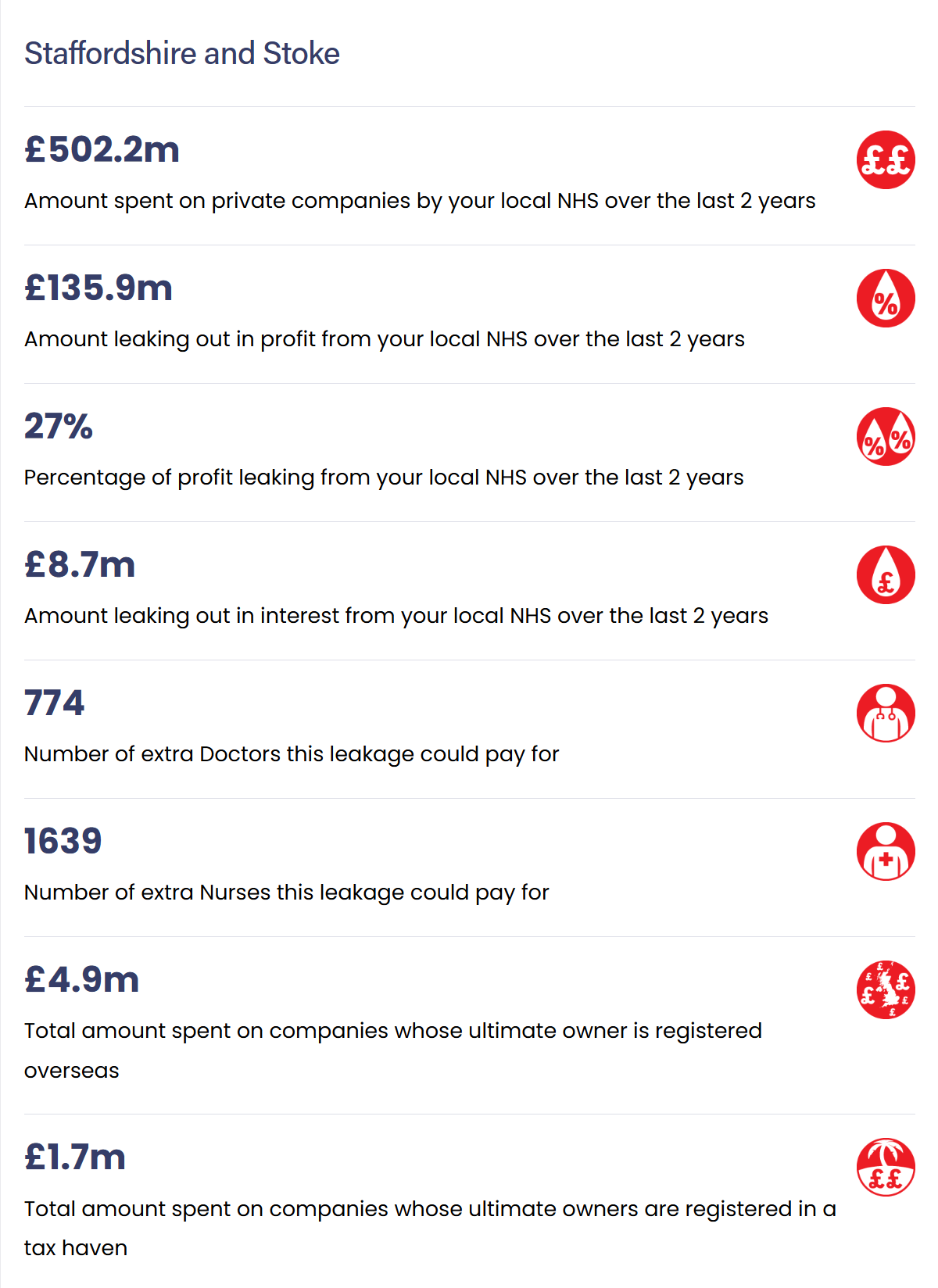
The think tank has also launched an online NHS profit map, allowing people to search by postcode to see its estimated figures for their local NHS area. CHPI says the tool is intended to show how much money is leaking out in profit, what proportion of spending that represents, and what those sums could equate to in doctors or nurses.
CHPI also raises concerns about ownership and debt. In the Staffordshire and Stoke-on-Trent area, the organisation says £4.9 million of the £502.2 million spent on the private sector went to companies whose ultimate owners are based outside the UK, and that £1.7 million of that went to firms whose owners are based in tax havens. It also says £8.7 million of NHS spending locally went towards paying interest on private sector debt. These figures are attributed to CHPI’s local analysis.
Nationally, CHPI says £2 billion of analysed NHS spending went to companies whose ultimate owners are registered outside the UK, £533 million went to companies whose owners are registered in tax havens, and £352 million went towards interest payments on private sector debt. The organisation argues that this raises wider questions about accountability, taxation, and how public money is used once NHS contracts are awarded.
In response to the findings, David Rowland, Director of the Centre for Health and the Public Interest and author of the research, said:
“Given the massive pressures faced by the NHS in Staffordshire and Stoke-on-Trent, the large amounts of profits which are leaking out of the NHS to private companies urgently needs to be looked at both by central government and local NHS leaders.
When looking at how to achieve the very large savings needed to keep the NHS afloat in Staffordshire and Stoke-on-Trent the first port of call should be a cap to stop private companies making excessive profits from NHS funding.”
UNISON Head of Health Helga Pile said:
“NHS contracts shouldn't be a cash cow for the private sector to take hundreds of millions of pounds.
The health service needs to make every penny count given current funding constraints. This money would be better used to transform services for patients, increase staffing levels and boost pay. The government must act to ensure taxpayers' money isn’t used to swell the coffers of private firms.”
CHPI is calling for a cap on the profits of companies with NHS contracts, a limit on the amount of debt those companies can hold, full transparency about where money paid to private firms ends up, and a requirement for all companies providing NHS services to be tax registered in the UK.
Enjoyed this story?
As a Community Interest Company, we reinvest every penny into Staffordshire journalism. Your tips help us keep our reporting "Open Access" and free for everyone.
Support the Mission (Tip Jar)Every contribution stays in Staffordshire. Thank you for being part of the journey.

Explore the heart of our county Use the interactive map above to discover local landmarks, heritage sites, and community-vetted spots. Every interaction helps support The Staffordshire Signal’s mission to keep local news free and independent.
Sources and methodology
This article is based on research published by the Centre for Health and the Public Interest, together with NHS England’s Financial Performance Report for Quarter 3 of the 2025/26 financial year.
CHPI says its analysis draws on spending transparency data from all 42 NHS Integrated Care Boards and NHS England for the financial years 2023/24 and 2024/25. The organisation states that it identified £12 billion of NHS spending on 760 private companies where sufficient financial data was available for analysis.
CHPI says its figures are estimates rather than audited totals. Its analysis uses EBITDA, or Earnings Before Interest, Tax, Depreciation and Amortisation, as a measure of profitability. The organisation also states that the study does not include all NHS private sector spending, and excludes areas such as pharmacy, dentistry, opticians, pharmaceutical products, Private Finance Initiative contracts, and other private sector spending by NHS trusts.
The NHS deficit figure referenced in this article comes from NHS England’s Financial Performance Report for Quarter 3 of 2025/26:https://www.england.nhs.uk/long-read/financial-performance-report-2025-26-quarter-3/
CHPI also states that, for the purposes of its research, the jurisdictions classed as tax havens were Jersey, the Cayman Islands, Gibraltar, Guernsey, the British Virgin Islands, Bermuda, Luxembourg, and Hong Kong. The organisation says this classification is supported by analysis from the Tax Justice Network.
The research project was funded by the Friends Provident Foundation. CHPI says expert advice on the project was provided by Professor Anne Stafford of Alliance Manchester Business School and Professor Colin Haslam of Queen Mary University of London.
Readers can explore the original CHPI research and NHS profit map here:https://www.chpi.org.uk/https://www.nhsprofitmap.org.uk/
A full geographic breakdown of CHPI’s analysis is available through its postcode tool and associated published material.


